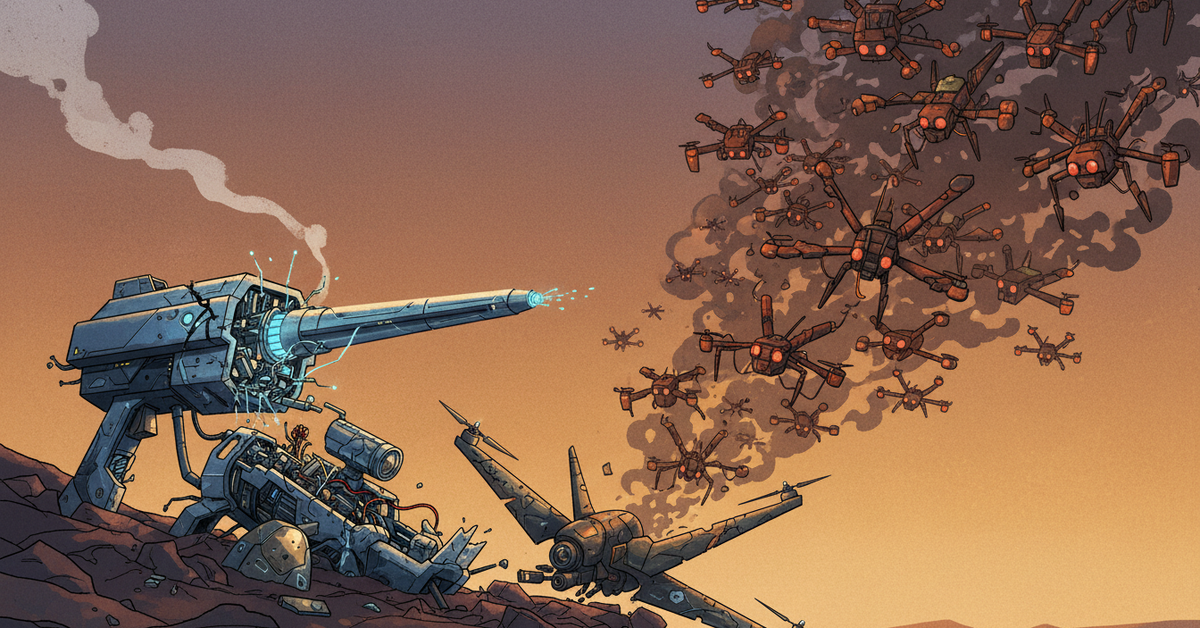
Ukraine’s most valuable new export is not a weapon, but a method. Having honed its skills in the crucible of a years-long war, its specialist military units are now reportedly deployed in several Middle Eastern countries. They sell not hardware but hard-won experience in how to intercept and destroy enemy drones. This commercialisation of battlefield intellect signals a crucial maturation in the market for counter-unmanned aircraft systems (C-UAS). The contest has expanded beyond building a better jammer to mastering the operational art of using it.
The shift is born of necessity. The proliferation of cheap, lethally effective drones—from the Red Sea to the Donbas—has overwhelmed traditional air-defence models. Firing a missile that costs millions of dollars to down a drone worth as much as a family car is a losing equation. The sheer volume of threats makes a purely technological solution unsustainable. Militaries are concluding that the answer lies in how they organise, train and fight. The "software" of doctrine and human expertise is becoming as critical as the hardware itself.
The Netherlands is putting this idea into practice. In a move watched closely by NATO allies, the Dutch armed forces are embedding dedicated C-UAS units directly into all combat brigades. This transforms counter-drone capability from a scarce asset, hoarded at senior command, into a standard component of frontline formations. Much like machine-guns a century ago, drone-hunting is becoming a core competency for every soldier. The Dutch are betting that a proficient network of operators will defeat a swarm more effectively than a handful of silver bullets.
This “detect-confirm-engage” sequence, orchestrated by well-drilled operators, conserves expensive ammunition and reduces the system's electronic signature, making it harder for the enemy to find and destroy.
This new operational art is less about a single wonder-weapon and more about a system of systems. On the ground, it might involve a cheap, wide-area network of acoustic sensors listening for the tell-tale buzz of propellers. Once a potential threat is detected, its bearing is passed to an electro-optical camera for visual confirmation. Only then is a high-value asset, like a directional jammer or a kinetic interceptor, activated. This “detect-confirm-engage” sequence, orchestrated by well-drilled operators, conserves expensive ammunition and reduces the system's electronic signature, making it harder for the enemy to find and destroy.
This evolution is creating openings for a new kind of defence firm. The market is no longer the exclusive preserve of industry titans. Consider Dedrone, a company whose AI-driven platform claims to have virtually eliminated false positives in detection. Or Britain’s Roke, which in July 2024 launched a portable system designed for rapid deployment. These firms, and others like them, are thriving in a market projected to reach $20.31 billion by 2030, up from $6.64 billion in 2025. Their selling point is not just a box of electronics, but a constantly updated service that includes training and tactical advice. Their advantage lies in a deep understanding of the threat.
The implications for military procurement are profound. Defence ministries are structured to buy expensive things—tanks, ships, jets—over decades. This model is ill-suited to a threat that changes every few months. It suggests a necessary shift in budgets, away from pure capital expenditure and towards operational spending on constant training, software upgrades and, crucially, retaining skilled personnel. A first-rate drone hunter is an asset as valuable as a fighter pilot, but their career paths and incentives are not yet structured to reflect that. Western militaries must move from buying platforms to cultivating talent.
To be sure, advanced technology is indispensable. No amount of clever doctrine will stop a sophisticated, high-speed drone without powerful sensors and effectors. The Ukrainian teams exporting their knowledge still rely on advanced electronic-warfare gear. But the hardware is in a constant race with its target. As C-UAS systems improve, drone operators adapt. They are developing autonomous flight paths that do not rely on jammable GPS signals, employing AI to coordinate swarms that can overwhelm a single point of defence, and building drones that can hop between radio frequencies to evade electronic disruption. This relentless cycle of innovation on both sides means that technology alone offers only a fleeting advantage.
For decades, Western armies pursued technological superiority as an end in itself. Now, it is merely the price of admission. The new differentiator is cognitive superiority: the ability to learn, adapt and disseminate new tactics faster than the enemy. As drones become cheaper and smarter, the premium will be on the human network that counters them. For a generation, Western militaries sought to take the man out of the loop. In the war against the drone, they are discovering the loop is all that matters.