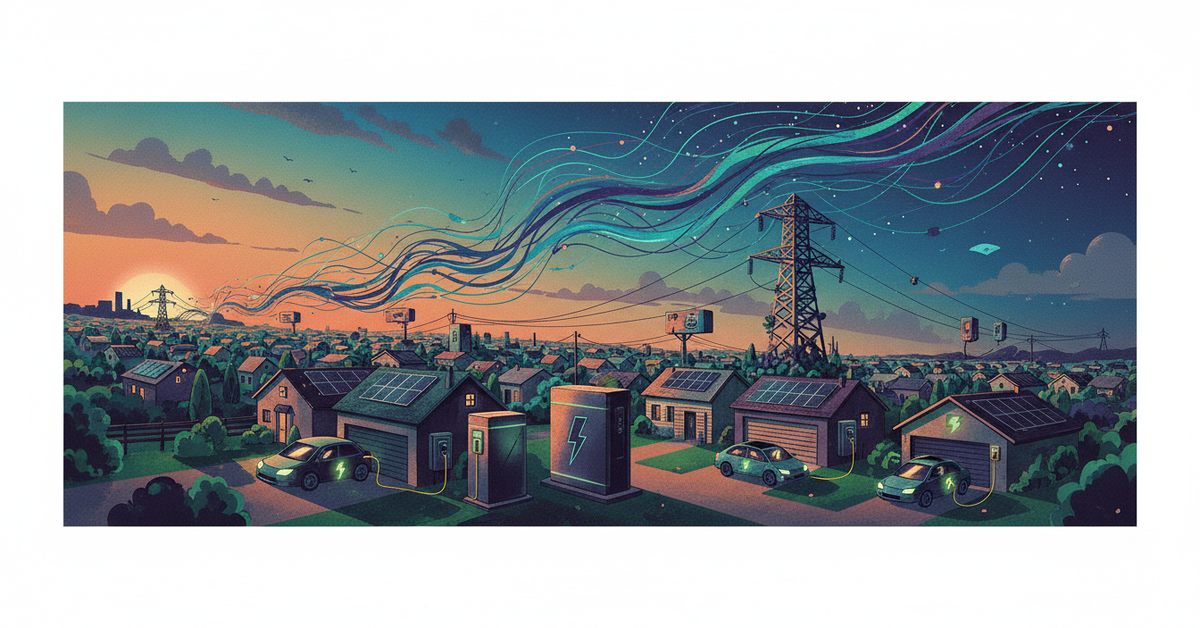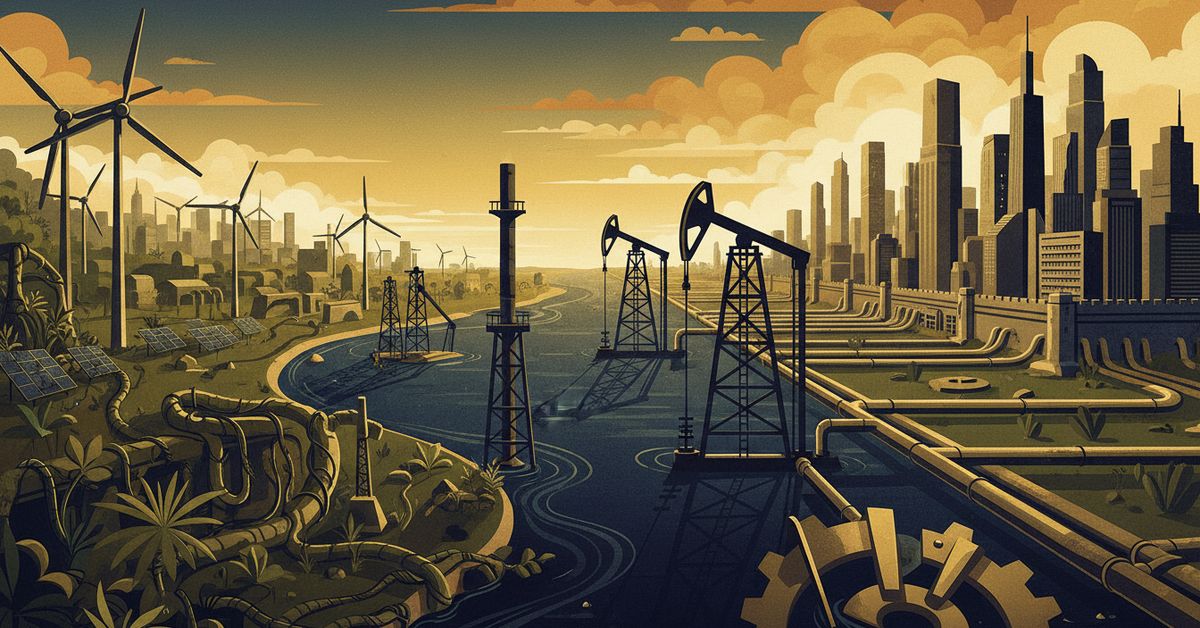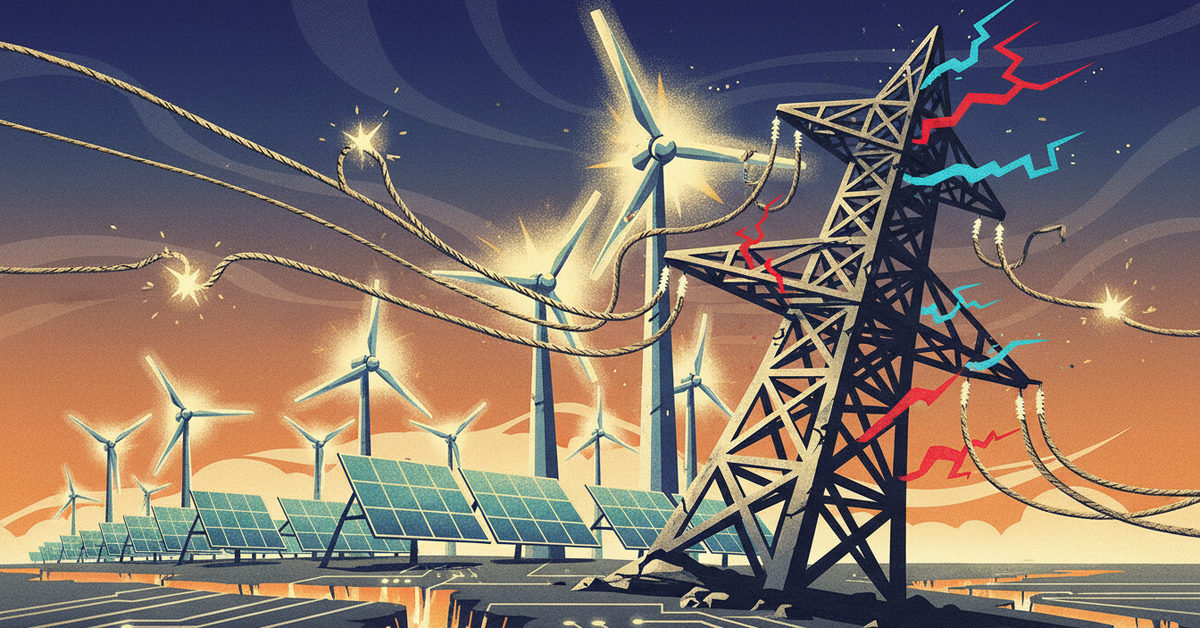
The surest sign of the green-energy boom’s success is how often its product is worthless. In the first ten months of 2025, the wholesale price of electricity in Germany, the Netherlands and Spain was negative for more than 500 hours each. On windy, sunny days, producers of renewable power had to pay to offload their electricity onto a grid that simply could not absorb it. This is not a market quirk. It is a symptom of a profound and dangerous mismatch at the heart of the global energy transition.
While capital pours into building new solar and wind farms, the essential infrastructure needed to transport their power is being neglected. The imbalance is growing. Global investment in clean energy is set to hit $2.2 trillion in 2025, double the amount spent on fossil fuels. Yet of the money flowing into electricity, the wires are losing out to the widgets. For every dollar spent on grids, roughly two and a half are spent on power generation. Annual investment in the world’s electrical grids stands at about $400 bn. The International Energy Agency (IEA) warns this is dangerously inadequate.
This underinvestment is not accidental. It is systemic. Private capital naturally chases the faster, higher returns of generation projects. Regulated utilities, meanwhile, are often hesitant to propose the vast, decade-long capital expenditures required for major transmission upgrades, fearing rejection by regulators who must ultimately pass the costs to consumers. The result is a collective failure to invest in the common circulatory system of a modern energy economy.
The consequences are measured in wasted energy and billions of euros. When a grid cannot handle the electricity generated, operators must resort to “curtailment”—ordering a wind or solar farm to shut down. In the first nine months of 2025, wind power curtailment in Europe hit record levels. Spain was forced to discard 12.2% of its potential wind generation. The direct economic cost of this deliberate waste across just seven European countries reached €7.2 bn in 2024. The power was there. The plugs were not.
For investors, this creates a perverse reality: the more successful their renewable projects are collectively, the less valuable their individual output becomes at peak times.
This systemic strain warps market signals. Negative prices are a distress flare, indicating a system so saturated with intermittent power that it has no way to store the surplus for a cloudy, still evening. For investors, this creates a perverse reality: the more successful their renewable projects are collectively, the less valuable their individual output becomes at peak times. This volatility threatens the very bankability of the projects needed for the next phase of the transition.
In America, a backlog of 2,600 gigawatts (GW) of projects—mostly solar, wind and batteries—is waiting for a grid connection. That is more than double the country’s entire existing power-generation capacity. The median wait time for a project to clear this queue is now approaching five years. Europe’s predicament is little better. It has a 1,700 GW queue of its own. In some markets, a wind-farm developer can expect to wait up to nine years for a grid-connection permit. The IEA warns that, on the current trajectory, some 1,500 GW of advanced renewable projects worldwide could be stalled by these delays.
China, the world’s largest builder of renewables, offers a different model. Its state-led, centrally planned approach allows it to build transmission lines in tandem with its massive generation projects, avoiding some of the fragmented, market-driven paralysis of the West. Yet even its integrated system is straining under the sheer scale of deployment. China’s challenge is less about planning permission and more about the physics of managing a continent-sized grid increasingly dominated by intermittent sources. Its experience suggests that even with political will, the engineering problems are immense.
To be sure, some see this as a healthy, if chaotic, market signal. They argue that the flood of cheap, intermittent generation is precisely the shock the system needs to spur investment in solutions. The glut of midday solar power creates a compelling business case for battery storage. The financing of projects like Fervo Energy’s advanced geothermal plant, which promises 24/7 clean power, shows that capital is hunting for ways to fill the reliability gap. In this view, generation must lead, creating demand for the grid and storage to follow.
Yet this view mistakes a structural chasm for a temporary pothole. Market forces alone will be too slow and uncoordinated to fix it. Building high-voltage transmission lines is a decade-long affair, snarled by planning laws, local opposition and supply-chain constraints for items like transformers. Policy must clear the way. In America, that means reforming the arcane cost-allocation rules that determine who pays for new interstate power lines. In Europe, it requires creating EU-level “priority corridors” to fast-track the permitting of cross-border grid connections. Without such a push, the energy transition risks stalling. The clean-energy machine is being built faster than the tracks it needs to run on.
The promise of the energy transition was not just cleaner power, but cheaper and more secure power. A system plagued by price volatility and reliant on curtailment fails on both counts. It erodes public support and gives ammunition to those who argue for a return to fossil fuels. What was an engineering problem is becoming a political one. For a generation, the climate fight was about making clean energy cheap. Now it is about making it useful.